
WE LET OUR OCEANS DIE
Who Is Really to Blame?
A Logical Investigation into Responsibility, Choice, and Moral Blindness.
Prologue: A Walk Along the Portuguese Coast
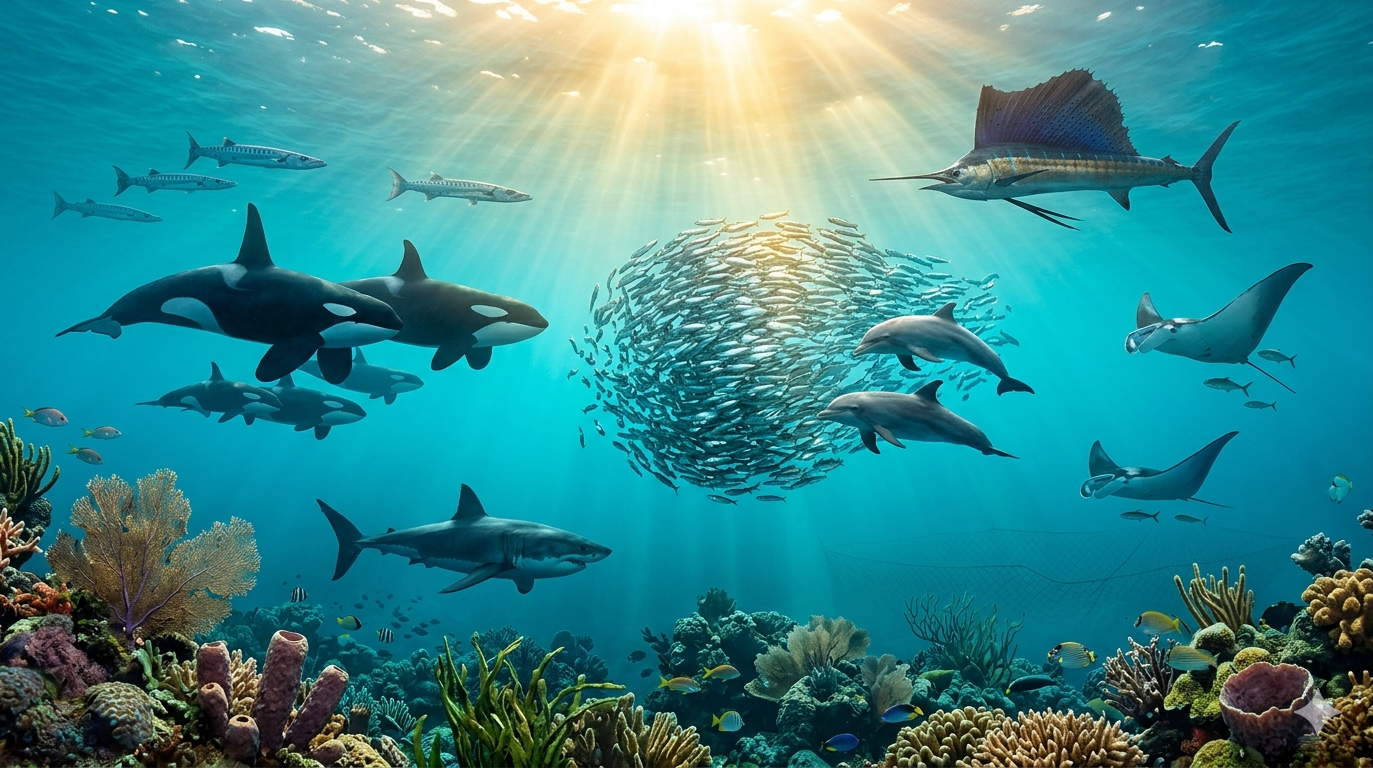
I walk along the coast of Portugal. Every day, I see the same sight. Large fishing boats, dragging nets hundreds of meters long, pulling tons of fish from the ocean. Day after day. Week after week.
The fish they catch are small now. The big fish are mostly gone. The numbers are devastating:
- 50% of all small fish have disappeared in the last 50 years.
- 90% of all big fish—tuna, marlin, swordfish—have disappeared in the same time.
The ocean is being emptied. And almost no one is talking about it.
But who is responsible?
This is not a simple question. It requires clear thinking. It requires us to look at the entire chain of responsibility—without comfort, without excuses, without looking away.
Part One: The Chain of Destruction
The Fisherman
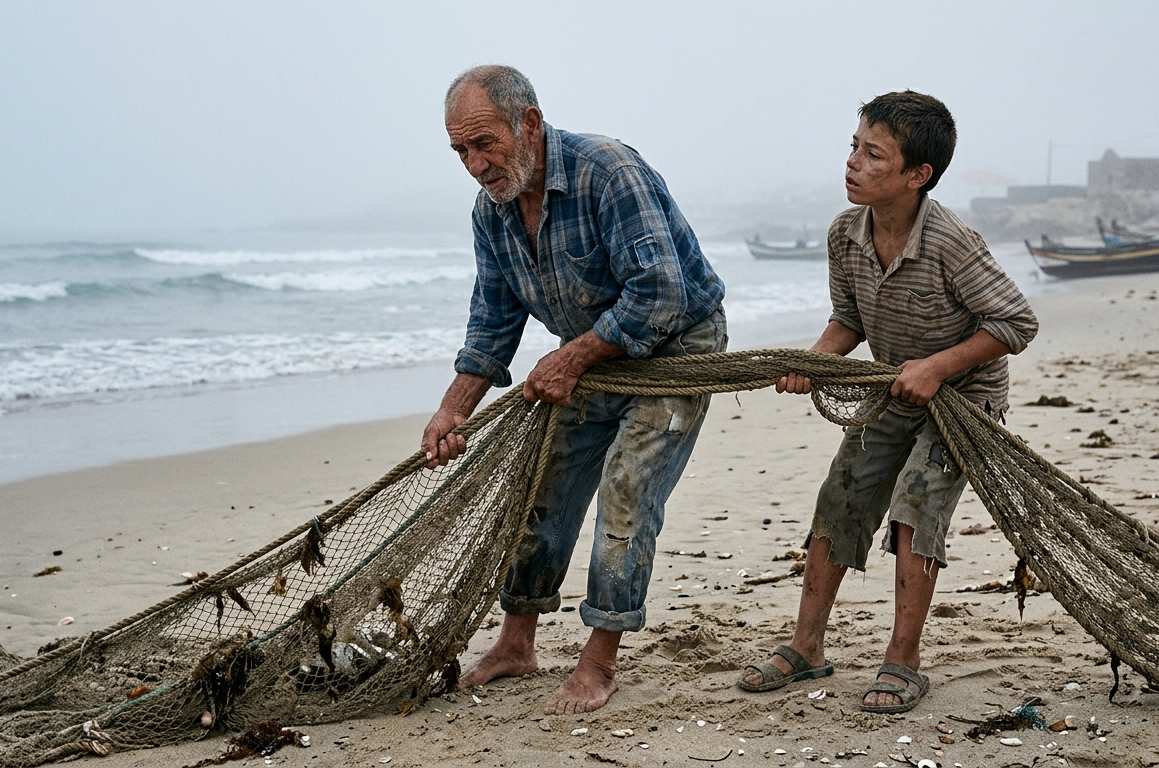
When I see the Portuguese fishermen, I do not see villains. I see poor men. Men who wake up before dawn. Men who work in dangerous conditions. Men who do this because they have no other choice.
These men are not rich. They are not powerful. They are not destroying the ocean because they want to. They are destroying the ocean because they need to survive.
At the end of the month, they need to feed their families. They need to pay the rent. If they do not fish, their children go hungry.
A person who acts out of desperation is not the same as a person who acts out of choice.
This is the first layer of responsibility.
The Migrant Worker
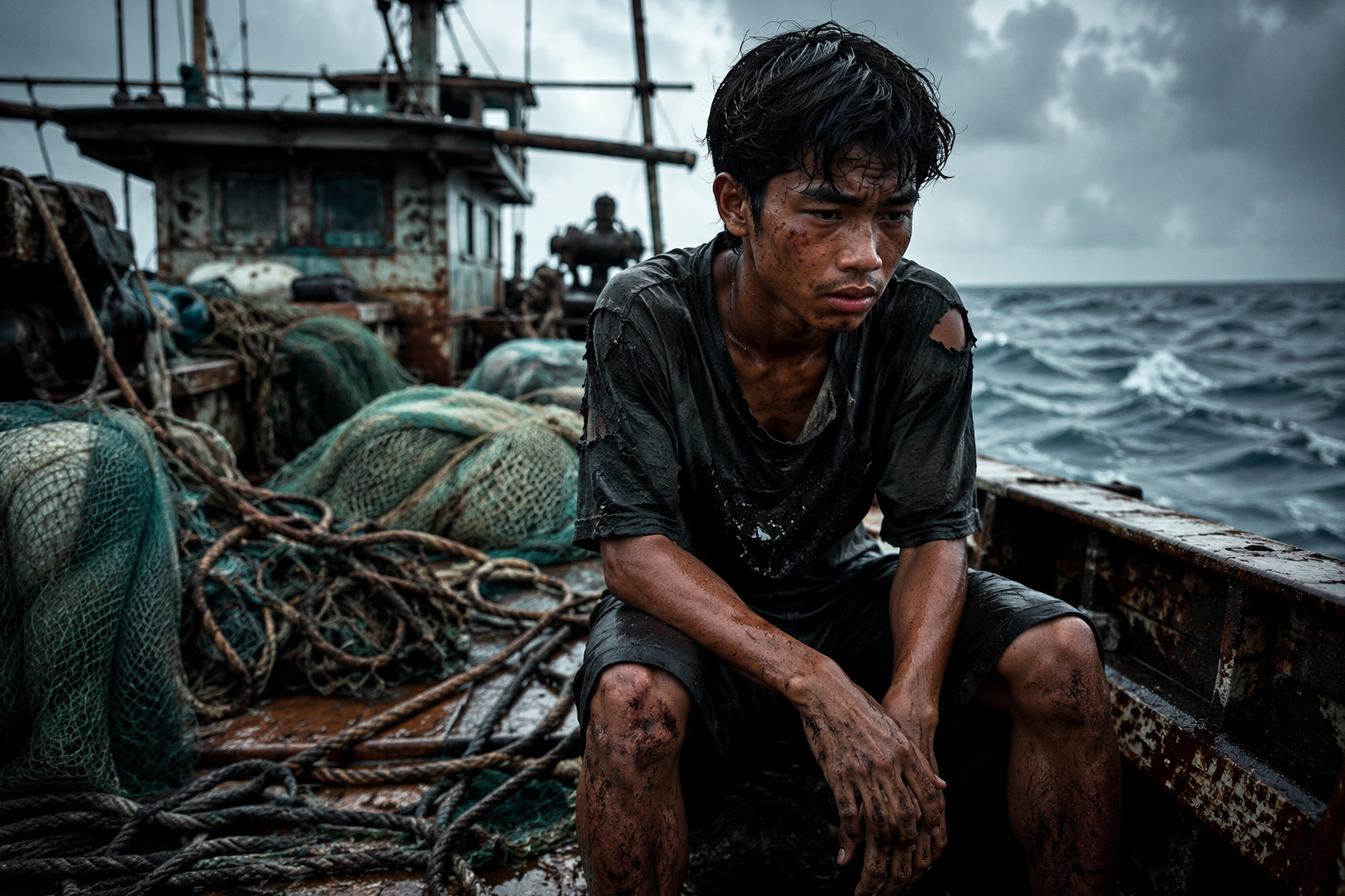
I have lived in Thailand. I have seen the men from Burma who work on the fishing boats. They come to a foreign country because there is no work in their homeland. No jobs. No future. No way to feed their children.
They work on boats for months at a time. They are paid almost nothing. They are treated badly. They are exploited.
These are not the villains either.
They are the victims of a system that has no room for them. They are the ones at the very bottom of the chain. They are the ones who are desperate.
The Corporation
Above the fishermen and the migrant workers are the companies. The large corporations that own the fishing fleets. The ones that build the massive nets. The ones that process the fish. The ones that sell to supermarkets and restaurants.
These companies are not desperate. They are not poor. They are not acting out of survival.
They are acting out of profit.
They know the ocean is being emptied. They know the fish populations are collapsing. But they continue because there is money to be made.
This is the second layer of responsibility.
The Government
Above the corporations are the governments. The ones who give subsidies to the fishing industry. The ones who create weak regulations. The ones who do not enforce the rules that exist.
Governments know what is happening. They have the data. They have the scientists. They have the power to change things.
But they do not.
Because changing things would mean angering powerful interests. It would mean losing votes. It would mean going against the corporations that fund their campaigns.
Governments are complicit.
They are not innocent. They are not blind. They are choosing to look away.
This is the third layer of responsibility.
The Consumer
And then there is the consumer.
The person in Europe. The person who earns thousands of euros a month. The person who has every choice in the world.
This person walks into a supermarket and sees:
- Fresh fish
- Tinned fish
- Frozen fish
- Fish from all over the world
This person can choose anything. They can choose beans. They can choose lentils. They can choose tofu. They can choose chicken. They can choose vegetables. They can choose food that does not destroy the ocean.
But many of them choose the fish anyway.
Why?
Because it tastes good. Because it is convenient. Because they are used to it. Because they do not think about where it came from.
This is the consumer. This is the person who has the power to stop the destruction but does not use it.
This person is responsible too.
Part Two: The Logic of Responsibility
The Murder Analogy
Imagine this:
You pay someone to kill your neighbor. You give them the money. You tell them when to do it. You tell them how to do it. They go and kill your neighbor.
Who goes to prison?
You both do.
The killer goes to prison. And you go to prison. Because the law recognizes that the person who pays for the murder is just as guilty as the person who commits it.
You cannot pay someone to kill for you and claim you are innocent.
Now apply the same logic to the ocean.
The consumer pays the supermarket. The supermarket pays the corporation. The corporation pays the fisherman. The fisherman takes the fish from the ocean.
Who is responsible?
Everyone in the chain.
The fisherman is responsible—but he is desperate. He has no other choice. His responsibility is small.
The corporation is responsible—but it is responding to demand. If no one bought the fish, they would not catch it.
The government is responsible—but it is responding to powerful interests.
And the consumer?
The consumer has the most choice. The consumer has the most power. The consumer has the most alternatives. And yet the consumer continues to pay for the destruction.
The consumer is the primary driver of the entire system.
Without consumer demand, there would be no fishing industry. There would be no huge nets. There would be no empty oceans.
The Question of Survival vs. Preference
This is the key difference that most people refuse to see.
The Portuguese fisherman is not choosing between fish and something else. He is choosing between fish and hunger. Between fish and his children going to bed without dinner. Between fish and being unable to pay the rent.
That is survival. That is desperation.
The European consumer is not choosing between fish and hunger. They are choosing between fish and beans. Between fish and lentils. Between fish and a thousand other foods that do not destroy the ocean.
That is preference. That is comfort. That is convenience.
These two situations are not the same. They are not morally equivalent.
The desperate fisherman is not the villain. He is the victim of a system that offers him no other path.
The comfortable consumer is not a victim. They are a participant in destruction they could easily avoid.
Part Three: What This Means
The Moral Hierarchy of Responsibility
If we look at the chain logically, we see a clear hierarchy:
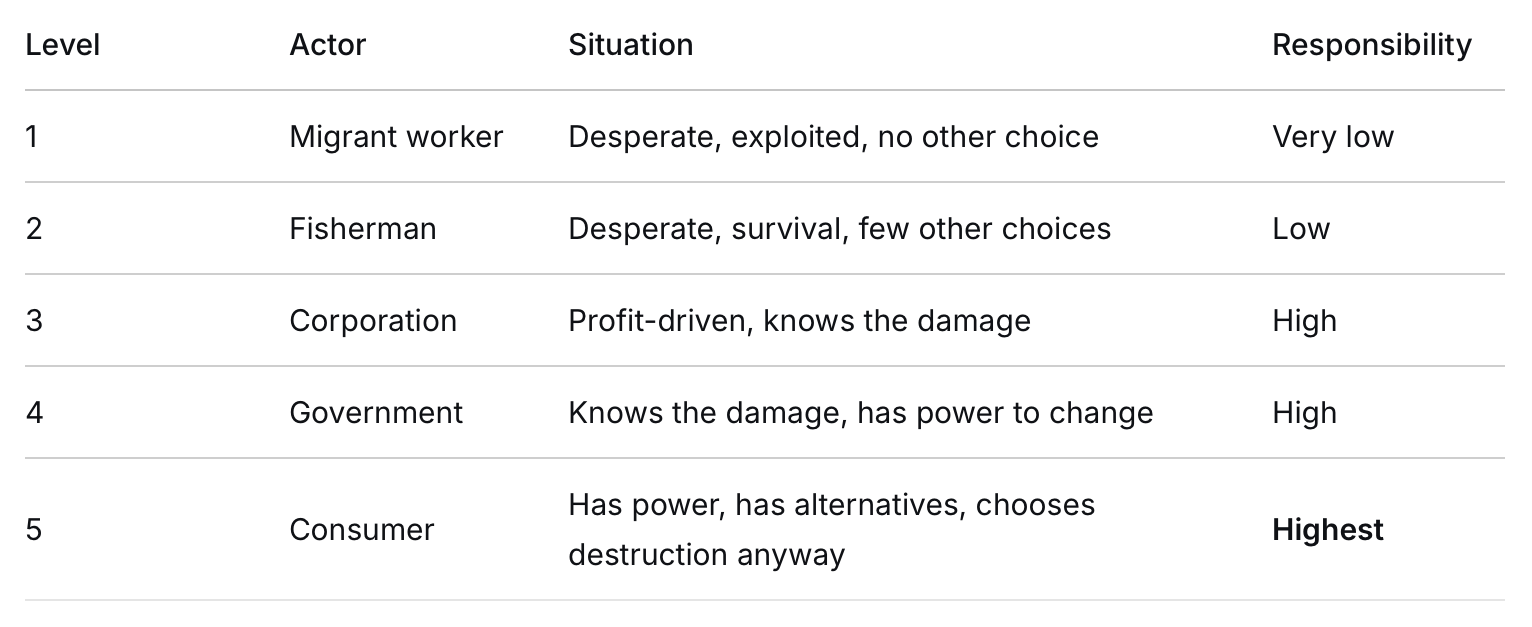
The consumer is at the top of the chain. The consumer is the one who enables everything below.
Without the consumer, the corporation would not fish. The government would not subsidize. The fisherman would not catch.
The consumer is the engine of destruction.
The Inconvenient Truth
This is not a comfortable truth. Most people do not want to hear it.
They want to blame the big corporations. They want to blame the governments. They want to blame the fishermen. Anyone but themselves.
But the truth is inconvenient.
If you eat fish, and you have other choices, you are part of the problem.
This is not a moral judgment. This is a logical fact.
You are paying for the destruction of the ocean. You are funding the empty nets. You are supporting the collapse of marine life.
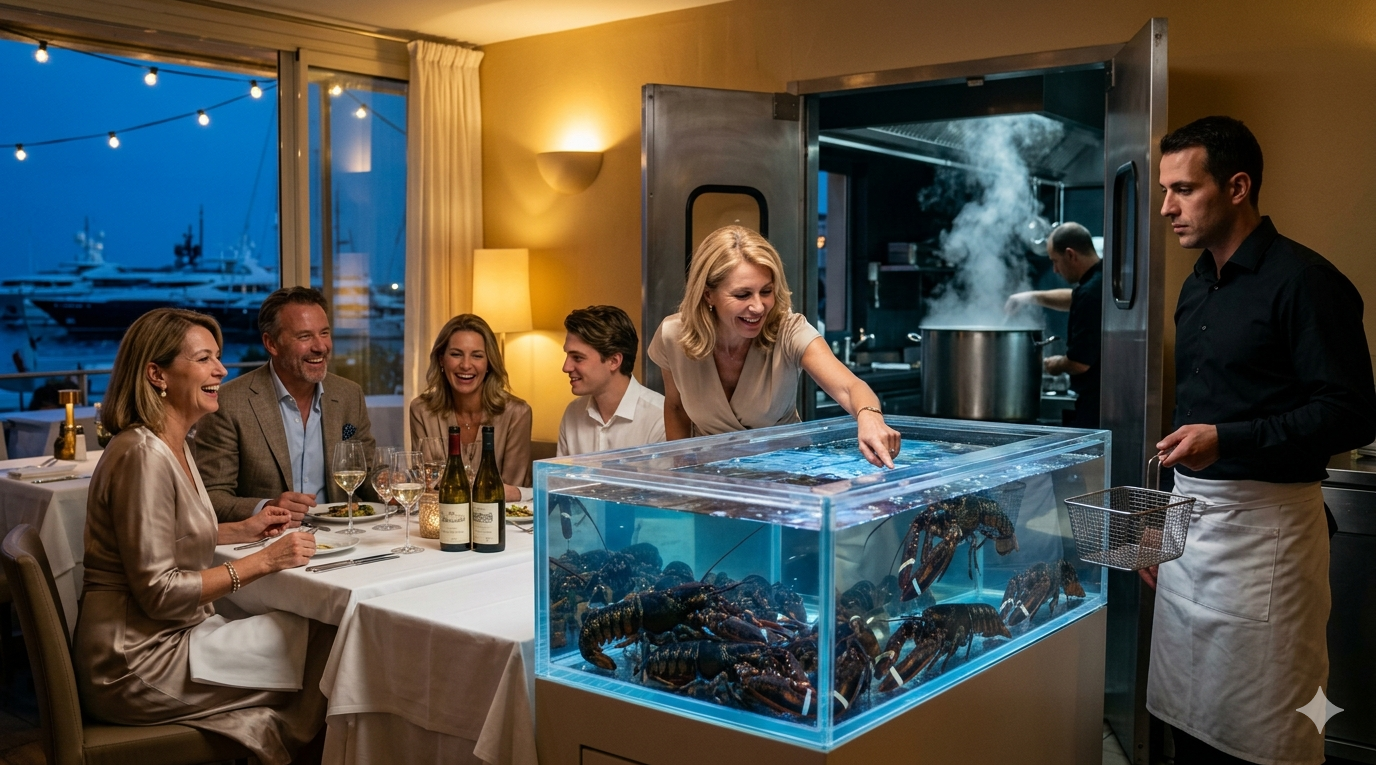
You are, in effect, paying someone to kill the ocean for you.
Part Four: The Path Forward
What the Consumer Can Do
The consumer has the most power. The consumer also has the most responsibility.
Here is what the consumer can do:
- Stop eating fish. It is that simple. If you stop buying, the industry stops catching.
- Choose alternatives. Beans, lentils, tofu, vegetables, grains—there are thousands of foods that do not destroy the ocean.
- Demand change. When you go to a supermarket, ask where the fish comes from. Ask if it is sustainable. If it is not, do not buy it.
- Talk to others. Share this truth. Help other people see their responsibility.
The consumer is not helpless. The consumer is not innocent. The consumer has power.
Use it.
What the Government Can Do
The government has power too. It can:
- Stop subsidies. Stop giving money to an industry that is destroying the ocean.
- Enforce regulations. Create and enforce strict limits on fishing.
- Protect marine areas. Create protected zones where fish can recover.
- Educate the public. Tell people the truth about where their food comes from.
What the Corporation Can Do
The corporation also has power. It can:
- Stop overfishing. It knows what it is doing. It can stop.
- Invest in alternatives. Develop sustainable alternatives to wild-caught fish.
- Be transparent. Tell consumers where the fish really comes from.
Conclusion: The Mirror of Truth
We cannot solve this problem by blaming only the fishermen. We cannot solve it by blaming only the corporations. We cannot solve it by blaming only the governments.
We must solve it by looking in the mirror.
The consumer who has choices and still chooses destruction is the engine of the entire system. Without their money, the system would collapse. Without their demand, the ocean could recover.
This is not about being perfect. This is about being honest. This is about recognizing that the one who pays for destruction is as responsible as the one who does the destroying.
We have a rule for this in our legal system. If you pay someone to kill, you are guilty of murder. You do not get to claim innocence just because you did not pull the trigger.
The same logic applies to the ocean.
If you pay for the destruction of the ocean, you are guilty of destruction. You do not get to claim innocence just because you did not cast the net.
A Question for the Reader
Look at your plate.
Where did that fish come from? Who caught it? Who paid for it?
And most importantly: Could you have chosen something else?
If the answer is yes, then you have a choice.
And what you choose matters.
The ocean is dying. The fish are disappearing. The ecosystem is collapsing.
We can still stop it. But only if we are honest about who is really responsible.
It is not just the fishermen. It is not just the corporations. It is not just the governments.
It is us.
Final Words
The truth is simple:
"The one who pays for destruction is as responsible as the one who does the destroying."
Do not look away. Do not blame the desperate. Do not hide behind corporations and governments.
Look in the mirror.
And then choose differently.
– Igor Lofing
"Logic is the path of intelligence."
Postscript
This article is free to copy, distribute, and share. The truth belongs to everyone. Share it freely. The ocean is dying, and we are the ones who can save it—if we choose to.